Everything Is Probabilistic: Why AI Doesn’t Reason or Know Facts

AIMachine LearningLLMsProbabilityReasoning
AI models don’t think or know facts. They generate outputs by estimating probabilities, which can mimic reasoning but isn’t true reasoning.
Overview
Modern artificial intelligence, especially large language models (LLMs), often looks like it reasons and knows facts. But under the hood, everything is probabilistic. AI doesn't understand; it predicts the most likely output based on patterns in its training data.
Everything is probabilistic
LLMs are probability machines. Given input text, they calculate the likelihood of possible next tokens and select the most probable sequence. This is why they can write essays, solve math problems, or answer questions—they're playing the odds with incredible scale and accuracy.
Why AI doesn’t reason
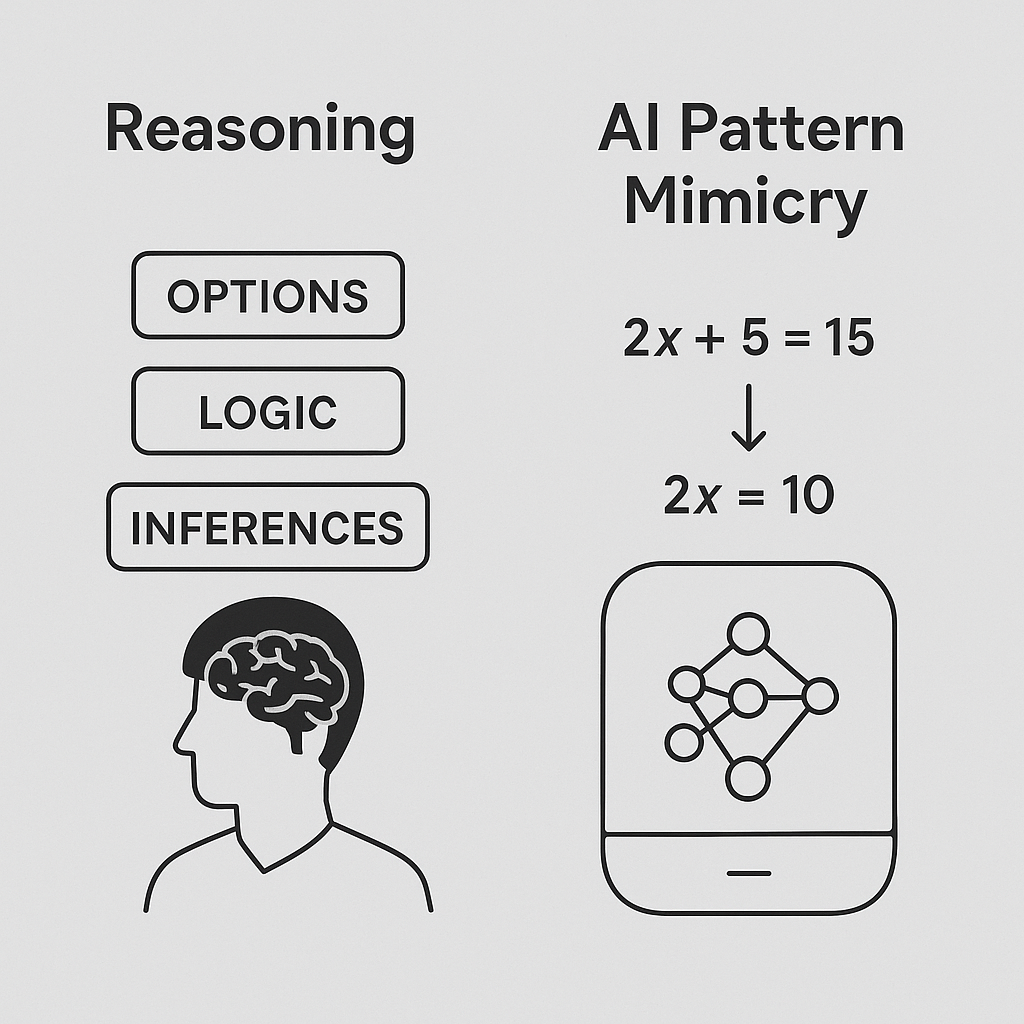
Reasoning implies deliberate thought: weighing options, applying logic, and making inferences. AI doesn’t do that. Instead, it chains together statistically likely patterns that mimic reasoning. When an LLM solves a math problem step by step, it’s reproducing how humans usually write solutions—not thinking through logic itself.
The illusion of knowledge
Humans store facts in memory. AI doesn’t. It doesn’t have a structured database of truth—it encodes patterns in billions of parameters. When those patterns align with reality, it can output accurate information. When they don’t, it produces errors or “hallucinations.”
AI doesn’t *know* Paris is the capital of France—it just predicts that “Paris” is the statistically most likely word to follow “The capital of France is…”
AI doesn’t *know* Paris is the capital of France—it just predicts that “Paris” is the statistically most likely word to follow “The capital of France is…”
Why this matters
If we treat AI as an oracle of facts, we risk misusing it. Recognizing its probabilistic nature helps us:
- Double-check outputs against reliable sources
- Use it for brainstorming, drafting, and discovery—not blind truth
- Value its strengths in fluency and scale while remaining cautious about accuracy
Humans vs. AI
Humans also operate probabilistically when making judgments, but we combine probability with true reasoning, memory, and understanding. AI can simulate reasoning and fact recall, but it can’t *reason* or *know* in the human sense.
Conclusion
AI’s power lies in prediction, not knowledge. Everything it generates is probabilistic, not the product of reasoning or stored facts. If we understand this, we can use AI responsibly—as a tool for generating possibilities, not as a substitute for human reasoning.